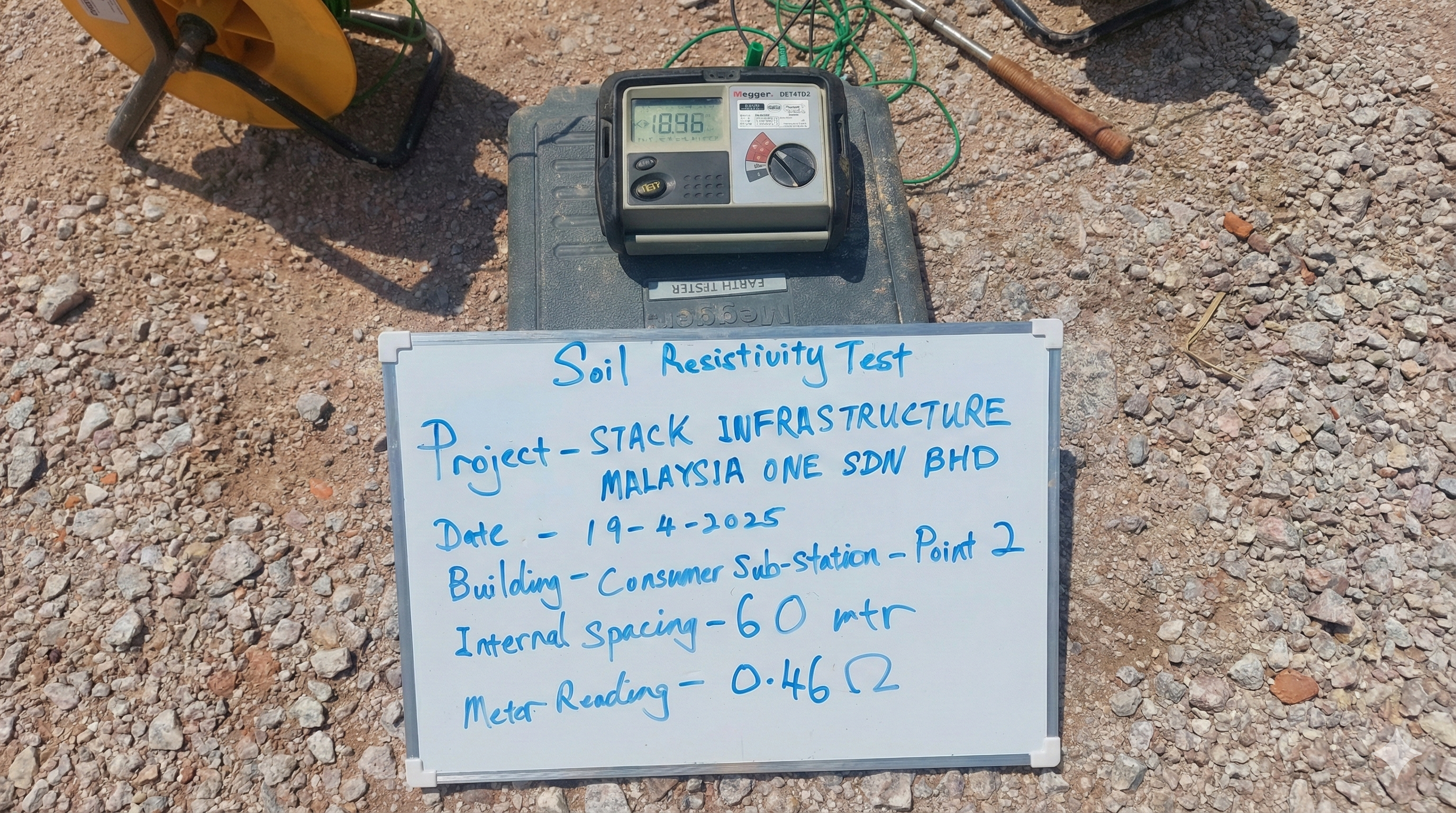
Soil Resistivity Test
Accurate soil resistivity assessment is the foundation of every effective earthing and lightning protection system. At Deltric Holdings, we approach soil resistivity testing as a critical engineering exercise, not a procedural formality. Our testing methodologies provide reliable, data-driven insight into actual ground conditions, enabling the design of grounding systems that perform safely under real fault and lightning events.
Before any earthing or lightning protection system is installed, Deltric ensures that essential pre-engineering investigations are completed. Unlike traditional practices that rely on limited or single-point measurements, our approach is built on engineering accuracy, repeatability, and compliance.
Why Soil Resistivity Testing Matters
- Ground resistance directly affects fault current dissipation and lightning energy discharge
- Incorrect assumptions can lead to unsafe step and touch voltages
- Poor data often results in over-designed or under-performing systems
- Accurate testing enables optimized design and material selection
Our Testing Approach
- Conduct structured, multi-point soil resistivity measurements to reflect real site conditions
- Analyze variations across depth, location, and soil composition
- Eliminate reliance on outdated methods such as single earth rod readings
- Generate engineering-grade data for grounding system modelling and calculations
Engineering & Compliance Focus
- Test data used directly in earthing system design calculations
- Supports compliance with IEC and BS earthing standards
- Enables accurate design of earth grids, electrodes, and enhancement methods
- Reduces long-term safety and performance risks
Client Value & Differentiation
- Grounding systems designed on measured reality, not assumptions
- Improved safety margins for personnel and equipment
- Cost-efficient designs through accurate material sizing
- Greater confidence during testing, commissioning, and authority approvals
At Deltric, soil resistivity testing is treated as a non-negotiable engineering step. By replacing guesswork with precise data, we ensure that every grounding system is designed for safety, compliance, and dependable long-term performance.